


Managing a law firm’s finances involves unique compliance requirements and financial workflows that differ from other industries. Law firms must follow specific ethical rules and operate under strict financial regulations. Even small errors can lead to penalties or violations if not handled correctly.
According to the Wolters Kluwer Annual Accounting Industry Survey, keeping up with new or changing regulations remains one of the top challenges law firms face. Because of these complexities, law firm accounting requires specialized oversight that general accounting may not fully cover.
A professional who focuses on this area is known as a legal accountant. They understand the financial systems, trust accounting rules, and compliance requirements specific to law firms. In this guide, we’ll explore what a legal accountant does and whether hiring one is the right move for your firm.
What Is a Legal Accountant?
A legal accountant is a financial professional who specializes in accounting management for law firms. Their role focuses on handling financial processes that require an understanding of trust accounts, IOLTA compliance, and maintaining financial records in accordance with legal and ethical standards.
Unlike general accountants, legal accountants are familiar with the specific regulatory framework that governs legal practice accounting. They oversee financial reporting, trust account reconciliations, expense tracking, and law firm billing structures.
To become a legal accountant, one must typically earn a degree in accounting or finance. Some hold certifications such as a CPA license, while others develop expertise through experience working within law firms or legal service organizations.
Defining Law Firm Accounting
Law firm accounting refers to the financial processes and systems specific to legal practices. It includes areas such as trust accounting, client retainers, billing, and partner distributions.
Unlike many other industries, law firms must follow accounting rules established by state bar associations for handling of client funds. As a result, legal accounting processes are typically more regulated and require strict compliance.
Duties and Responsibilities of a Legal Accountant
A legal accountant’s workday involves managing financial operations and regulatory compliance for law firms. Their responsibilities help protect the firm from financial and ethical risks. Below is a breakdown of what a legal accountant commonly does:
- Manage trust accounts and IOLTA compliance. Legal accountants oversee trust deposits and disbursements to ensure strict separation of client and operating funds.
- Perform three-way trust reconciliations. They reconcile the trust bank statement, individual client ledgers, and the trust control account to identify and correct discrepancies.
- Prepare financial statements and internal reports. From profit & loss statements and balance sheets to cash flow reports, legal accountants generate regular financial reports to reflect the firm’s financial position.
- Manage accounts payable and receivable. They oversee vendor payments, expense tracking, invoice processing, and monitor outstanding client balances.
- Oversee payroll and expense management. Legal accountants process attorney and staff payroll while monitoring overhead, reimbursements, and operational expenses to maintain financial control.
- Manage tax compliance and audit support. Prepare financial documentation, coordinate with CPAs and tax professionals, and maintain organized records to support financial and regulatory audits.
- Advise financial performance. Legal accountants provide financial insights into profitability, budgeting, and overall financial strategy to support informed decision-making.
Legal Accountant vs. General Accountant
A legal accountant focuses on the specific financial operations of law firms. They understand trust accounting rules, bar compliance requirements, and the billing models commonly used in legal practices.
A general accountant handles standard financial management across various industries. They handle standard bookkeeping, tax preparation, and financial reporting, but it does not usually involve legal-specific compliance requirements.
Both roles share foundational accounting skills. However, a general accountant lacks aspects that a legal accountant familiarity with the specific rules that govern legal accounting.
Qualifications and Skills of a Legal Accountant

A legal accountant combines technical accounting knowledge with industry-specific regulatory awareness. They must understand both financial systems and legal compliance requirements. Here are key qualifications and skills to look for when evaluating a candidate or hiring for this role.
- Certification: CPA (Certified Public Accountant) license may be preferred but is not always required.
- Degree: Bachelor’s degree in accounting, finance, or a related field.
- Software Skills: Proficiency in legal accounting software such as Clio, CosmoLex, or QuickBooks.
- Trust Accounting: Understanding of IOLTA account management and the ability to perform monthly three-way trust reconciliations.
- Ethics: Strong knowledge of legal confidentiality standards and fiduciary duty.
- Financial Reporting: Ability to prepare profit & loss statements, balance sheets, and cash flow reports
- Attention to Detail: Strong accuracy in financial recordkeeping and the ability to identify discrepancies.
- Billing Management: Understanding of law firm billing structures, collections processes, and partner compensation models.
- Communication skills: Ability to explain complex financial reports and provide clear financial guidance to attorneys and firm leadership.
What Is the Salary of a Legal Accountant?
The average salary for a legal accountant in the United States is at $60,452 per year, with reported salaries ranging from around $30,000 to $112,000 per year, according to data from ZipRecruiter. This equates to approximately $29.06 per hour based on a full-time schedule.
Compensation can vary depending on factors such as experience level, firm size, geographic location, and level of specialization. Legal accountants working in major metropolitan areas, such as New York or Los Angeles, often earn higher salaries due to increased demand and a higher cost of living compared to smaller or rural markets.
Why Trust Accounting Is Important for Law Firms
The American Bar Association Model Rule 1.15 sets the national standard for how attorneys must handle client funds and property. While it is a model rule, most states have adopted it in full or with minor modifications, making it the ethical foundation of trust accounting across the United States.
Trust accounting requires client funds to be held in a separate trust account and never commingled with a firm’s operating funds. Because it governs how attorneys handle money that does not belong to them, it is one of the most strictly regulated aspects of running a law firm.
IOLTA Compliance
Most states require attorneys who hold short-term or nominal client funds to deposit those funds into an IOLTA account. IOLTA stands for Interest on Lawyers’ Trust Accounts. It is a pooled, interest-bearing trust account where earned interest is directed to state-administered programs that fund legal aid and public service initiatives.
Given the regulatory requirements and potential disciplinary consequences for errors, many law firms turn to legal accountants for professional support.
Benefits of Hiring a Legal Accountant for Law Firms
As an attorney, managing your firm’s finances yourself takes valuable time away from the legal work that requires your expertise. A legal accountant allows you to delegate complex financial and compliance responsibilities. Key benefits include:
- Reduce Risk: Helps avoid financial mismanagement that can lead to audits, penalties, suspension, or even disbarment.
- Reliable Financial Data: Provides accurate financial reports, giving firm owners real-time visibility into financial performance for better business decisions.
- Save Time: Frees attorneys to focus on client matters and billable legal work instead of accounting and compliance tasks.
- Improved Cash Flow: Monitors receivables, collections, and billing performance to strengthen liquidity and reduce aged balances.
- Peace of Mind: Ensures trust accounts, payroll, expenses, and financial records are properly maintained.
- Stronger Compliance: Maintains IOLTA accounts and ensures adherence to state bar trust accounting rules.

Limitations of Legal Accountants
Like any professional role, legal accountants have defined limitations that should be considered.
- A legal accountant cannot provide legal advice or represent clients, as their responsibilities are strictly financial and compliance-focused.
- Their expertise centers on managing trust accounts, financial reporting, and regulatory compliance—not legal strategy or casework.
- Because they handle sensitive financial and client information, their role also requires strong confidentiality practices and proper internal controls within the firm.
Best Practices When Working With a Legal Accountant
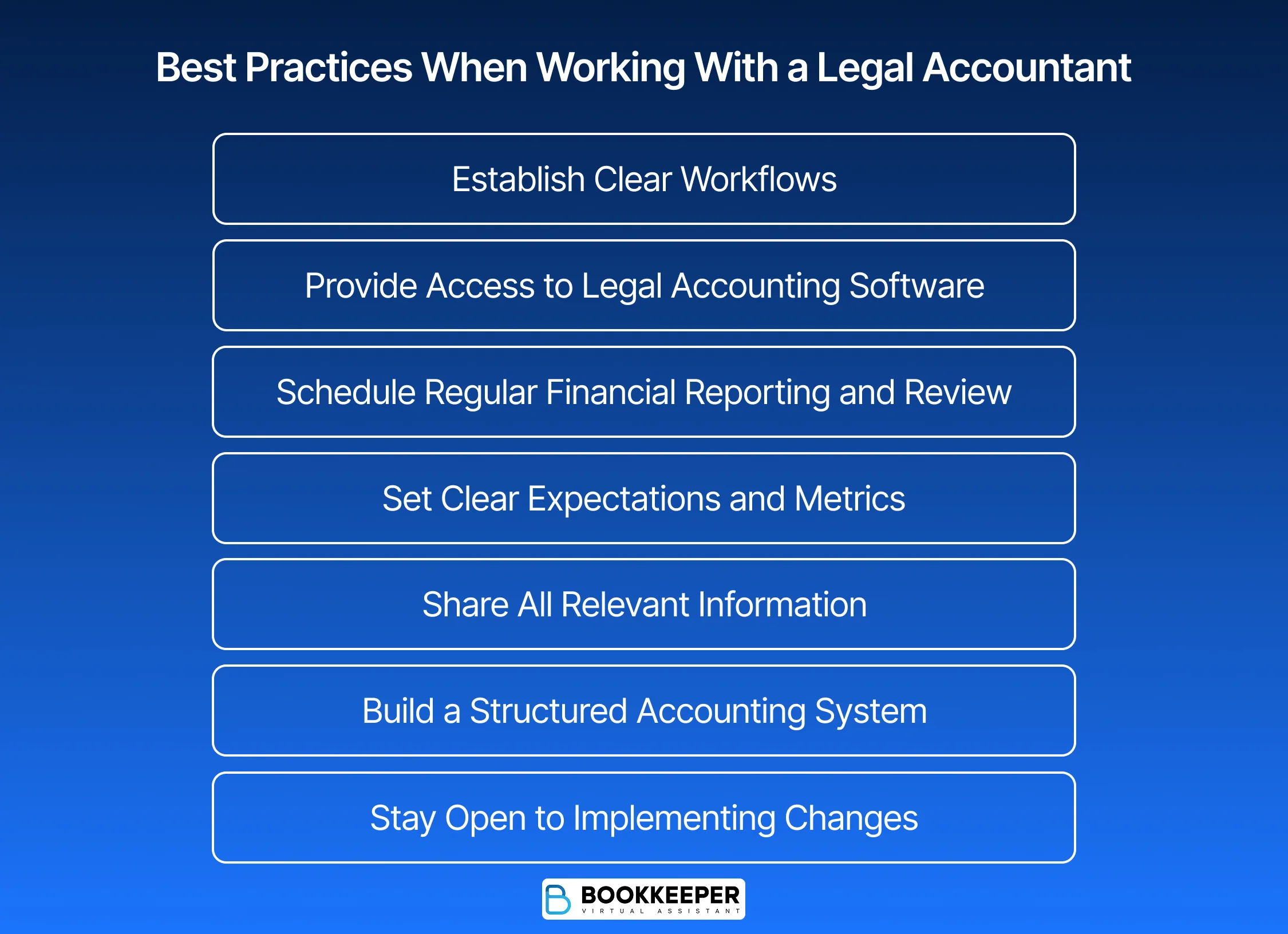
Legal accountants can work with your firm in several ways. They can be full-time, part-time, or brought in on a project basis. Some firms hire in-house, others work with remote legal accountants, and some choose to outsource entirely.
Regardless of the arrangement, the following best practices help you get the most out of the relationship and work effectively together.
Establish Clear Workflows
Define how financial information moves through your firm from the start. This includes how attorneys log billable hours, how expenses are submitted, and how billing data is delivered to your accountant. Setting clear deadlines for billing, reconciliations, and payroll helps prevent delays and reduces confusion.
Provide Access to Legal Accounting Software
Give your law firm accountant access to the right tools from day one. Legal accounting software helps them manage financial processes specific to legal workflows, access real-time data, and generate reliable reports. Without the right system access, even a skilled accountant cannot work efficiently.
Schedule Regular Financial Reporting and Review
Set a recurring time—at least monthly—to review financial reports together. Ask questions if specific numbers or trends seem unclear. Reviewing these regularly helps you catch issues early and understand where your firm stands financially.
Set Clear Expectations and Metrics
Agree upfront on what success looks like. This could include turnaround times for reconciliations, deadlines for monthly reports, or targets for collection rates. Having defined metrics keeps both sides accountable and makes performance easy to evaluate.
Share All Relevant Information
Your law firm accountant can only work with what you give them. Keep them informed about new fee arrangements, upcoming large expenses, and any client billing disputes. The more context they have, the more strategic their guidance will be.
Build a Structured Accounting System
Consistency in categorizing expenses, recording income, and labeling transactions simplifies reporting and audit preparation. Work with your legal accountant to establish a chart of accounts that reflects how your firm actually operates.
Stay Open to Implementing Changes
Your legal accountant may identify inefficiencies or compliance risks in how your firm handles finances. Listen closely, and remain open to recommendations, such as refining processes, adopting new tools, or adjusting how certain transactions are recorded.
When Do I Need a Legal Accountant?
Not every firm needs a full-time legal accountant from the beginning. But there are clear signals it's time to consider hiring one:
- Financial tasks are taking time away from practicing law
- You’re managing multiple trust accounts without dedicated support
- You’ve experienced billing errors or cash flow challenges
- Collections are delayed or difficult to track
- Tax preparation has become overwhelming
- You’re planning to expand your team or open a new office
If these situations apply to your firm, a legal accountant can help bring structure and financial clarity to your operations. At Bookkeeper.law, we provide virtual legal accounting support built specifically for law firms. Our specialists work as an extension of your practice, helping manage accounting processes, compliance, and reporting.
Final Notes
A legal accountant is more than a numbers person. They are a specialized professional who understands the financial and regulatory demands that law firms operate under.
If your law firm manages client funds, proper accounting is not optional. As financial operations become more complex or compliance concerns increase, bringing in a qualified legal accountant can be your smart investment. With the right support, you can run a compliant, profitable practice.
Frequently Asked Questions
Can a legal accountant work remotely?
Yes, many legal accountants work remotely. With the accessibility of cloud-based legal accounting software, remote professionals can manage financial processes, reporting, and compliance effectively from off-site locations.
Do small law firms need a legal accountant?
Small law firms may not need a full-time legal accountant, but they can benefit from part-time or outsourced support. Trust accounting rules apply regardless of firm size. Even small law practices can reduce financial risk by working with someone who understands legal-specific accounting rules.
Can an accountant give legal advice?
No, an accountant cannot provide legal advice, as it falls outside their professional scope. Their role is limited to financial management, tax compliance, and accounting functions. If you need legal guidance, you should consult a licensed attorney.