


Trust accounts are the backbone of every law firm's financial integrity. When a client pays a retainer or settlement funds come through, that money doesn't belong to your firm; instead, it goes into a client trust account. The way you track those client funds can make the difference between a thriving practice and a disciplinary nightmare.
Lawyers have ethical duties to manage these funds properly, as set by bar associations. Mistakes are not taken lightly. Mishandling client funds—even unintentionally—can trigger audits, hefty penalties, and disciplinary action that could put your license at risk.
Errors in trust accounting happen to many law firms more often than you may think, but they’re avoidable. Three-way reconciliation is a process designed specifically for law firms to ensure every dollar in your trust account is accounted for, properly tracked, and fully compliant with legal and ethical obligations.
In this guide, we'll explain what three-way reconciliation is, why it matters, and how to implement it effectively in your firm.
Understanding Trust Accounting
A trust account, often called an IOLTA (Interest on Lawyers' Trust Accounts), is a special bank account where attorneys hold client funds. This includes retainers, settlement proceeds, escrow funds, and any money that belongs to clients rather than the firm.
The interest payments earned on pooled client funds in an IOLTA typically go to fund legal aid programs in your state. But the principal—the actual client funds—must remain completely separate from your firm's operating account at all times.
Key points about trust accounts:
- Separation of Funds: Every state bar requires attorneys to maintain detailed records of client funds as part of their ethical and legal obligations. You need to know exactly how much money you’re holding for each client at any given moment.
- Internal Tracking: Trust accounts must be reconciled with your trust account bank statements and individual client ledgers. This three-way verification process ensures accurate tracking of client funds and demonstrates compliance during any audit or inquiry.
- Ethical Obligations: Proper trust account management is required by law and professional conduct rules. Regular reconciliation is non-negotiable; most state bars mandate it monthly, and some require it even more frequently.
Your operating account is your firm's money. It's where you deposit earned fees, pay salaries, rent, and other business expenses. You have full discretion over these funds.
Trust funds, by contrast, belong entirely to your clients until they are earned or properly disbursed. Mixing trust and operating funds, even temporarily, is called commingling and is one of the most common ethical violations attorneys face.
The penalties for trust account violations are serious. Depending on the nature and extent of the problem, you could face:
- Formal warnings and public criticism
- Suspension of your law license
- Mandatory audits and supervision
- Client lawsuits for lost funds
- Criminal charges if funds were misappropriated
Even honest mistakes can trigger disciplinary proceedings. A simple bookkeeping error that temporarily overdraws a trust account can lead to overdraft notifications and an investigation by the state bar.
Trust accounting is about responsibility. This is not something you want to get wrong. Having a systematic approach to reconciliation protects both your clients and your career.
What Is a Three-Way Reconciliation for Trust Accounts?
Most businesses use two-way reconciliation for their bank accounts. This is the standard process of comparing your bank statement to your internal accounting records to make sure they match. It helps catch discrepancies such as missed or duplicated transactions.
When these two sources match, the account is considered reconciled. For a typical business, this provides sufficient verification that the books are accurate.
However, for law firms, two-way reconciliation isn’t enough. Trust accounts involve multiple clients, each with their own funds. You need to know not just that the total is correct, but that the correct amount is allocated to each specific client.
Two-way reconciliation may confirm that your total trust account balance is accurate, but it does not prove that the funds are attributed to the correct clients.
Three-way reconciliation is a verification process that compares three separate records to confirm accuracy. For law firm trust accounts, these three records are the bank statement balance, the firm’s trust ledger balance, and the total of all individual client ledgers.
When all three figures match, you’ve verified that the money in the bank equals what your books show and that those funds are properly allocated to the correct clients. This triple verification is the gold standard for trust account compliance.
Components of Three-Way Reconciliation
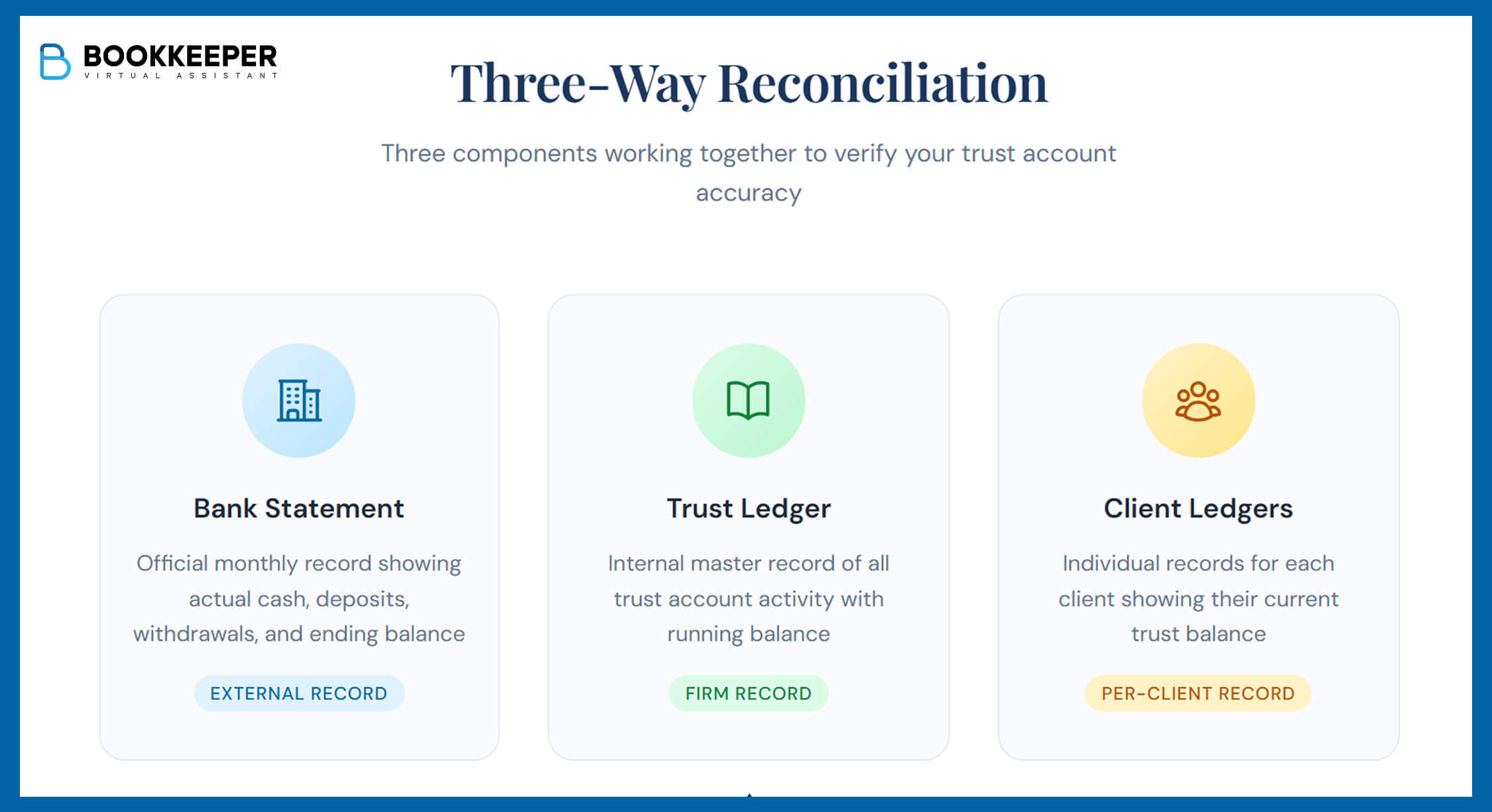
Understanding each component of three-way reconciliation helps you see how they work together to provide a complete picture of your trust account’s status.
Bank Statement
The bank statement is the official monthly record from your financial institution showing the actual cash on hand. It lists every deposit, withdrawal, and the ending balance for the statement period.
Keep in mind that the bank statement won’t reflect checks you’ve written that haven’t cleared yet or deposits that are still in transit. These timing differences must be adjusted during reconciliation.
Trust Ledger
The trust ledger is your firm’s internal record of all trust account activity. It tracks every transaction into and out of the account, including deposits, disbursements, transfers, and adjustments.
Each entry should include the date, amount, and description of each transaction, along with a running balance. Think of the trust ledger as your firm’s master record of what should be in the trust account based on all recorded activity.
Client Ledgers
Client ledgers are individual records for each client whose funds are held in trust. Every time money comes in or goes out on a client’s behalf, it's recorded in that client’s ledger, showing their current trust balance.
When you total all individual client ledger balances, the sum should match both the trust ledger balance and the adjusted bank statement balance. If it doesn’t, there’s an error that must be identified and corrected.
Why Three-Way Reconciliation Matters
Lawyers are trained to practice law, but running a law firm also means running a business, one that involves strict financial responsibilities. How you manage your firm’s finances forms the foundation of compliance, stability, and client trust.
Here's why three-way reconciliation is a non-negotiable part of your firm's financial management.
- Ensures regulatory compliance. Most state bars explicitly require regular trust account reconciliation as part of IOLTA compliance. Performing three-way reconciliation demonstrates your commitment to ethical obligations and keeps you prepared for random audits or client complaints.
- Catches errors before they become problems. Small discrepancies discovered during reconciliation are usually easy to correct. Left undetected, those same errors can snowball into major compliance violations.
- Detects fraud and unauthorized activity. Regular reconciliation is your first line of defense against internal theft or external fraud. Comparing three independent records makes unauthorized transactions much harder to hide.
- Provides documentation for audits. If the Bar Association calls, you’ll have a clear, well-organized paper trail ready. Complete and accurate records show that you take your fiduciary duties seriously.
- Protects client relationships. Proper reconciliation ensures clients can trust that their funds are handled professionally. This builds client confidence and peace of mind.
Following a consistent process makes three-way reconciliation manageable and ensures you don't miss critical steps.
4-Step Three-Way Reconciliation Process
Now that we’ve discussed what three-way reconciliation is and its key components, let’s walk through each step of the process and how to perform it correctly.
Step 1: Gather All Necessary Records
Start by collecting your bank statement for the reconciliation period, your internal trust ledger, and all individual client ledgers. Make sure all transactions through the statement date have been recorded in your internal systems.
Having organized, up-to-date records makes the rest of the process straightforward. If your records are incomplete, you’ll spend more time tracking down missing information than actually reconciling the account.
Step 2: Bank Statement Reconciliation with Trust Ledger
Compare your bank statement to your trust ledger. Begin with the bank’s ending balance and adjust for outstanding items such as checks written but not yet cleared, deposits in transit, and any bank fees or interest not yet recorded in your ledger.
Once adjusted, the bank balance should match your trust ledger balance. If it doesn't, investigate the difference before moving on. Common causes include unrecorded transactions, data entry errors, or duplicate entries.
Step 3: Total All Client Ledgers
Add up the ending balance from every individual client ledger. Include all clients with funds in trust, even those with small or inactive balances. This total represents the full amount of client funds your firm is holding.
Step 4: Perform the Three-Way Match
Now compare all three figures. They should be identical. The formula you're verifying is:
Bank Statement Balance = Trust Ledger Balance = Total of All Client Ledgers
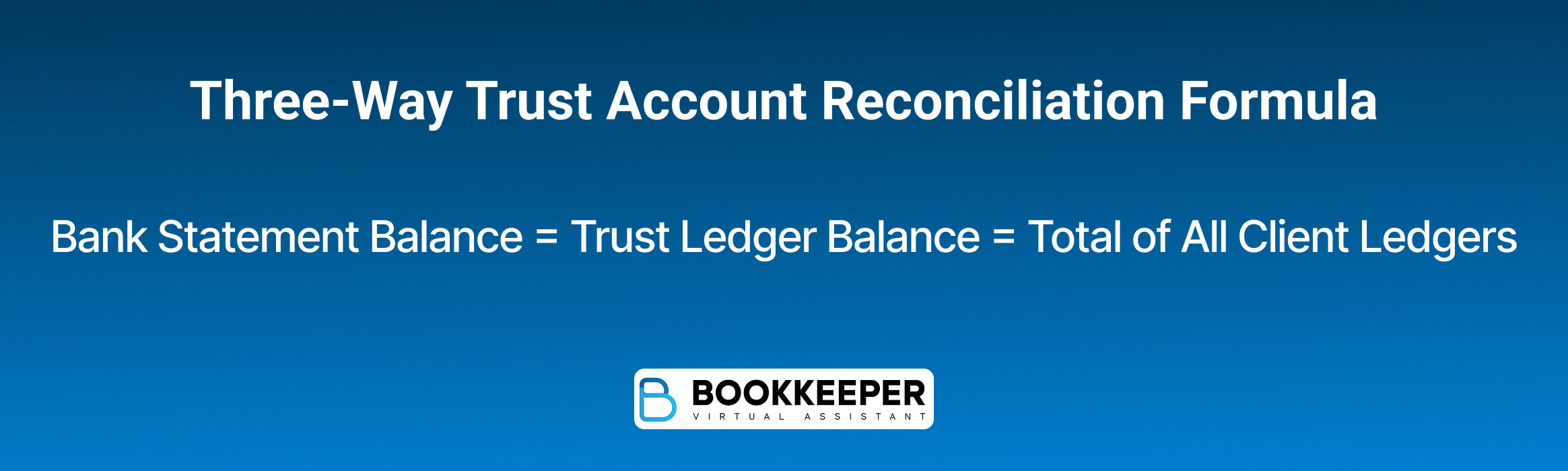
If all three match, your trust account is fully reconciled. Document your work, including the reconciliation date, the balances verified, and any adjustments made. Keep these records as proof of compliance.
If the figures don’t match, you have a discrepancy that must be investigated and resolved. Never skip this step or assume small differences don’t matter—every dollar must be fully accounted for.
How Often Should Law Firms Perform Three-Way Reconciliation?
In most states, bar associations require trust account reconciliation at least monthly, and this should be considered the minimum standard for your firm.
However, firms with high transaction volumes or multiple trust accounts may benefit from weekly—or even daily—reconciliations for very active accounts. The more transactions flowing through your trust account, the higher the risk of errors, and the greater the need for regular verification.
Best Practices for Three-Way Reconciliation
Following best practices makes the reconciliation process smoother and more effective. Keep these tips in mind:
1. Documentation and recordkeeping
Recordkeeping forms the foundation of strong financial management. Maintain precise documentation of every transaction and reconciliation.
According to ABA Rule 1.15 of the Model Rules of Professional Conduct, financial and safekeeping records must be retained for at least five years, even after the conclusion of each client engagement.
2. Compliance requirements
Understand your state bar’s specific requirements for trust account management and reconciliation. These vary by jurisdiction and may include reconciliation frequency, record retention periods, and reporting obligations. Staying current with rule changes ensures your firm remains fully compliant.
3. Use technology and software
Legal-specific accounting software can automate much of the reconciliation process, reducing manual errors and saving significant time. Look for software with features tailored for three-way reconciliation and that complies with your state’s trust account regulations.
4. Regular reconciliation schedule
Consistency is the best defense against accounting problems. Set a specific date each month (or more frequently for firms with high transaction volumes) for reconciliation, and treat it as a non-negotiable task. Regular scheduling prevents reconciliation from being delayed by urgent client matters.
5. Resolve discrepancies promptly
Investigate and correct any discrepancies immediately. Document the cause of the error, how it was resolved, and the steps taken to prevent similar issues in the future. Ignoring unresolved discrepancies can create larger problems and make them harder to track down over time.
6. Segregate accounts
Never deposit client funds into your operating account. Keeping client funds fully separate simplifies reconciliation and eliminates a common source of compliance violations.
Common Reconciliation Challenges to Avoid
Even the most diligent firms can fall into these common traps. Being aware of these pitfalls helps you prevent them.
- Procrastination. Putting off reconciliation is the most common mistake. The longer you wait, the harder it becomes to trace errors, and the greater the risk of compliance violations.
- Incomplete recording. Every transaction must be recorded in both your trust ledger and the appropriate client ledger at the time it occurs. Delays in recording create discrepancies that complicate reconciliation.
- Ignoring small discrepancies. A few dollars off may seem trivial, but it indicates a problem in your records that must be identified and corrected. There is no acceptable discrepancy in trust accounting.
- Relying on memory. Every adjustment, explanation, and correction should be documented in writing. If you can’t prove what happened during an audit, it’s as if it never happened.
- Commingling funds. Mixing client funds with your firm’s operating account is a serious ethical violation. It makes reconciliation more difficult and can trigger disciplinary action.
- Duplicate entries. Recording the same transaction more than once can throw off your balances and create confusion. Carefully reviewing every entry prevents these errors.
When to Use a Specialized Legal Bookkeeper
Trust account reconciliation requires both time and expertise to perform accurately. For many law firms, delegating this responsibility to a specialist helps minimize errors and ensures ongoing compliance.
Signs your firm may benefit from a legal bookkeeper:
- Reconciliation consistently takes longer than it should or is frequently delayed
- You or your staff lack confidence in trust accounting procedures
- Your firm is growing, and transaction volume is increasing
- You prefer to focus on practicing law rather than managing the books
- Frequent discrepancies appear in reconciliations
- A growing client load is straining your internal team
At Bookkeeper.law, we connect law firms with bookkeepers who specialize exclusively in legal accounting. They understand IOLTA requirements and the ethical obligations of managing client funds, giving you the freedom to focus on your clients.

Final Notes
Three-way reconciliation isn’t complicated once you understand the process. Whether you handle it yourself, assign it to staff, or work with a specialist, making it a priority is essential. The few hours you invest each month protect years of work building your practice and reputation.
Accuracy begins with consistency. Your clients trust you with their funds, and your state bar holds you accountable for that responsibility. Following best practices in trust account management not only honors that trust but also demonstrates your commitment to ethical, professional practice.