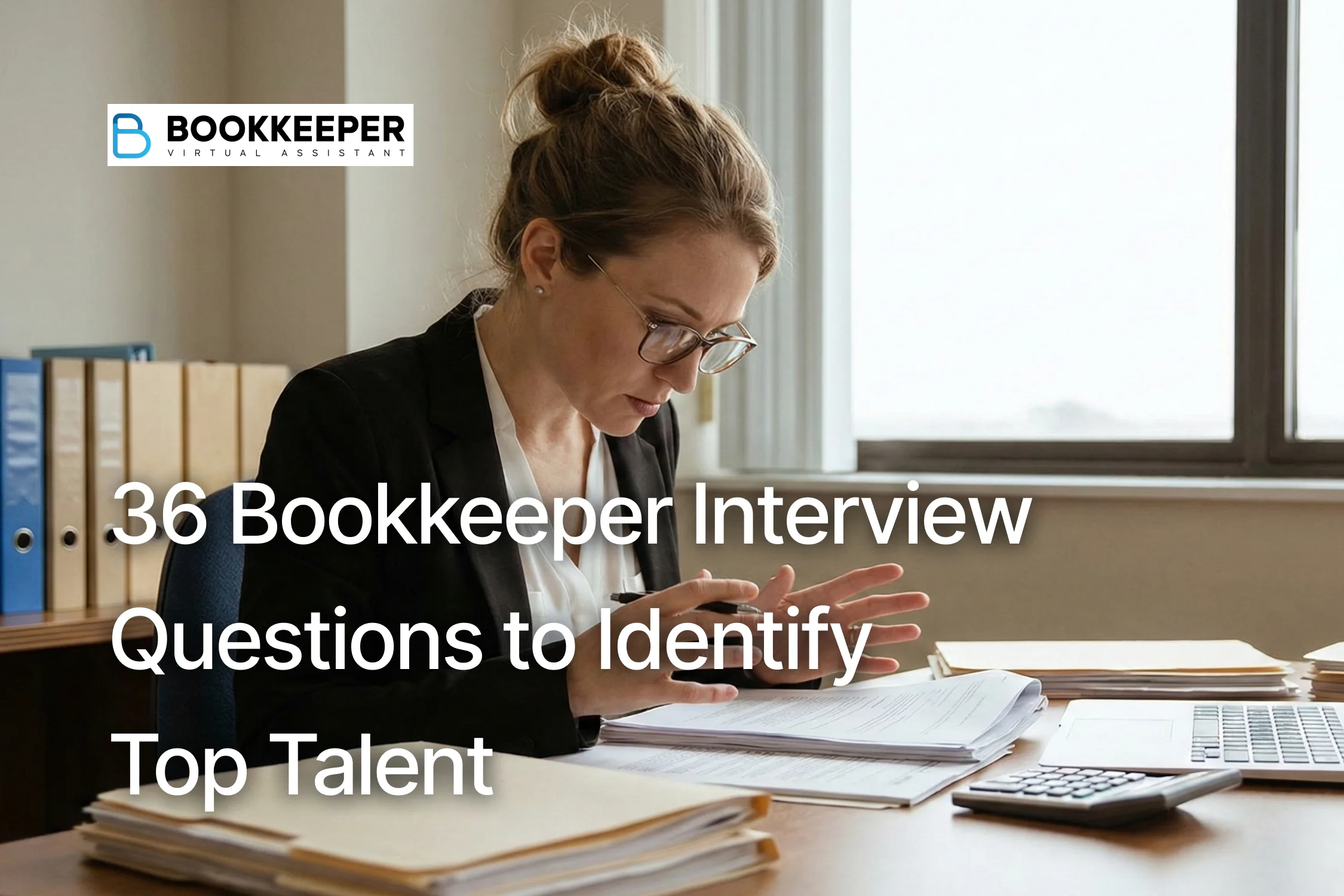

A bookkeeper is a financial professional responsible for recording and maintaining a company's daily financial transactions. Their core responsibilities include tracking income and expenses, reconciling accounts, managing payroll, and preparing financial records for accountants or auditors.
Finding the right bookkeeper is more than just hiring someone who is good with numbers. It’s about finding someone you can trust to help protect the financial health of your business.
The questions below are grouped by topic so you can evaluate both foundational bookkeeping skills and real-world decision-making. Use them to move past polished resume answers and identify the candidate who can actually do the job.
General Questions
Before diving into technical skills, general questions help you understand the candidate’s professional personality, communication style, and mindset. They are a good starting point for seeing how the person approaches their work.
1. Why did you choose bookkeeping as a career?
This tells you if they genuinely enjoy detail-focused financial work. Passion for accuracy and organization usually shows up here.
2. How do you stay organized when managing multiple deadlines or tasks?
You want to hear a clear system for managing recurring tasks and priorities. Look for practical answers involving calendars, checklists, workflows, or software tools.
3. What does a typical workday look like for you?
This gives insight into their work habits, prioritization skills, and whether their workflow fits your business needs.
4. How do you communicate financial information to someone without a bookkeeping background?
Bookkeepers often need to explain numbers to business owners who are not finance experts. Strong candidates can simplify financial topics without making them confusing.
Experience and Qualifications
A candidate's hands-on experience reveals a lot about what they can handle from day one. These questions explore the industries, systems, and bookkeeping responsibilities they’ve handled before.
5. How many years of bookkeeping experience do you have, and what industries have you worked in?
A bookkeeper who has worked in the same industry as your business may already understand your workflows, which can reduce training time.
6. What bookkeeping or accounting certifications or courses have you completed?
Certifications show initiative and a baseline standard of knowledge. This helps you measure how seriously they have invested in building their skills.
7. Have you ever managed the books for a business similar in size to ours? What did that look like?
Someone who has only handled small books may struggle with a larger operation—and vice versa.
8. What bookkeeping tasks have you handled from start to finish?
You want to know how complete their experience really is. Strong candidates should be able to describe their responsibilities in detail.
Behavioral and Situational Questions
These questions help you understand how the candidate responds under pressure and handles real workplace situations. Listen for specific examples rather than vague or hypothetical answers.
9. Tell me about a time you caught a financial error before it became a bigger problem. What did you do?
This tests attention to detail and proactive thinking. A strong candidate will walk you through the exact steps they took to identify and fix the issue.
10. Describe a situation where you disagreed with how something was being recorded. How did you handle it?
You want someone who can flag issues professionally without causing conflict. This also tests their understanding of proper accounting practices.
11. Have you ever had to deliver bad financial news to a business owner? How did you approach that conversation?
Bookkeepers sometimes have to be the bearer of uncomfortable information. Composure, tact, and clarity are important in these situations.
12. Tell me the time you have to deal with incomplete or unclear financial records. How did you manage it?
Candidates should explain how they verify details, ask questions, and organize messy financial information.
Technical Bookkeeping Skills
This is where you find out if the candidate actually knows their craft. Technical questions should feel natural for a qualified bookkeeper and demonstrate core bookkeeping knowledge.
13. Can you explain the difference between cash-basis and accrual accounting? Which have you used more often?
This is a fundamental concept and helps you see whether their experience aligns with how your business records transactions.
14. How do you handle month-end closing? What's your process?
A structured month-end process is a sign of a disciplined bookkeeper. Listen for specifics like reconciling accounts, reviewing entries, generating reports.
15. What's your process for identifying and correcting a discrepancy in the books?
Discrepancies can happen. The candidate should have a methodical approach to finding the root cause and preventing repeat errors.
Software Proficiency
Modern bookkeeping relies heavily on software and digital tools, so fluency matters. You don’t just want someone who has “used” a platform—you want someone who knows it well enough to troubleshoot and use it confidently.
16. Which bookkeeping or accounting software are you most proficient in, and how long have you been using it?
This helps measure familiarity with the tools your business may already use. Experience with your current software can help them integrate faster into your workflow.
17. What software features do you use regularly in your bookkeeping work?
This helps separate basic users from more capable ones by revealing how they apply features to real bookkeeping tasks.
18. How comfortable are you learning a new bookkeeping system?
Technology in bookkeeping evolves quickly. Willingness to adapt is a non-negotiable trait for long-term success.
Accounts Payable
Accounts payable management affects your cash flow and vendor relationships. These questions help you assess whether the candidate can manage outgoing payments carefully and on time.
19. How do you ensure vendor bills are recorded and paid correctly?
This reveals their process for logging invoices, verifying amounts, and scheduling payments. It should show attention to detail and consistency.
20. Have you ever handled invoice discrepancies or vendor billing issues? What steps did you take?
This tests both their problem-solving skills and integrity. Look for a systematic approach and how they catch issues before they affect your bank account.
21. How do you prioritize payments when cash flow is tight?
This reveals business awareness alongside technical skill. Clear prioritization and data-driven decision-making are signs of experience.
Accounts Receivable
Accounts receivable plays a key role in keeping revenue flowing in. These questions help you assess how the candidate manages invoicing, collections, and payment tracking.
22. How do you track outstanding invoices and follow up on overdue payments?
Look for a structured process like aging reports, follow-up schedules, escalation steps.
23. What's your approach to maintaining positive client relationships while collecting overdue payments?
Collections can damage relationships if handled poorly. You want someone who can protect cash flow while remaining professional with clients.
24. How do you ensure invoices are sent accurately and on time?
This helps you understand their invoicing workflow and recordkeeping practices.
Account Reconciliation
Reconciliation is one of the most important bookkeeping tasks because it helps catch errors and keep records accurate. A bookkeeper who approaches this with discipline and consistency helps protect your business from hidden financial issues.
25. How often do you reconcile accounts, and what's your process?
Monthly at minimum is standard. A detailed process answer shows they follow a clear, repeatable method.
26. How do you handle discrepancies during reconciliation?
This shows how the candidate responds when numbers do not match. Look for answers that describe a systematic approach to tracing discrepancies back to their source.
27. How do you handle old outstanding checks on a reconciliation?
This ensures they understand how to clean up records and follow proper procedures.
Financial Reporting
Financial reports help business owners understand what is happening in their company. Clear and accurate reports allow business owners to make better financial decisions.
28. What financial reports have you prepared or supported regularly?
Examples include profit and loss statements, balance sheets, and cash flow reports. Frequency should match your business needs.
29. How do you check financial reports for accuracy before sharing them?
This reveals whether they review their work carefully before it reaches management. Look for review steps such as cross-checking figures, comparing previous periods, and verifying source data.
30. Can you explain a complex financial report to someone with no accounting background?
A good bookkeeper should be able to explain reports in plain language. This evaluates communication skills as much as technical knowledge.
Handling Sensitive Financial Information
Bookkeepers often work around your most sensitive data like payroll, bank accounts, tax, and vendor information. Trust and discretion are essential.
31. How do you protect sensitive financial data in your daily work?
Listen for answers that include password management, restricted access, secure file sharing, and privacy awareness.
32. Have you ever handled confidential financial records or payroll information? How did you manage it?
This verifies whether they have experience handling private information responsibly. Look for professionalism and a clear understanding of confidentiality.
33. What security measures do you take when accessing financial data remotely?
Remote work is now common across many industries. You need to know if they take digital security seriously, regardless of where they work.
Payroll and Compliance
Payroll and compliance mistakes can create serious issues for a business and may trigger audits. These questions help you assess their accuracy and understanding of compliance requirements.
34. What’s your experience processing payroll, and which systems have you used?
Payroll experience varies widely. Make sure their background aligns with your payroll structure, business size, and any state-specific requirements.
35. How do you stay current with bookkeeping rules, tax requirements, or compliance changes that affect your work?
This shows whether they keep their knowledge up to date. A bookkeeper who's proactive about staying informed helps protect your business from compliance issues.
36. How do you make sure payroll is processed accurately and on time?
This reveals whether they have a dependable process for one of the most sensitive business functions.
What to Look for When Interviewing a Bookkeeper
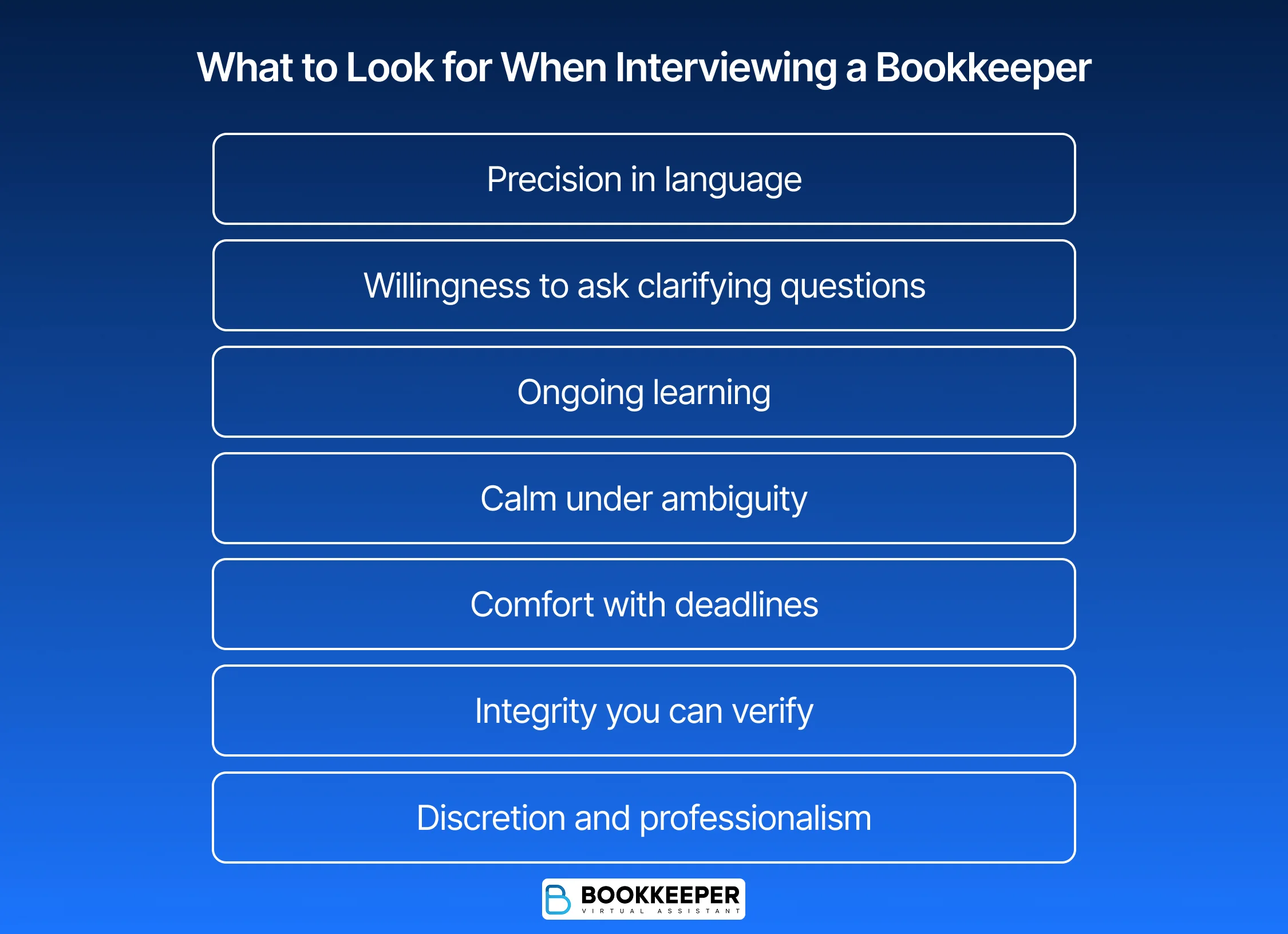
Beyond the answers themselves, watch for these signals:
- Precision in language: Great bookkeepers are exact in how they speak, not just how they calculate. They should be able to describe their workflows in specific steps.
- Willingness to ask clarifying questions: Candidates who want the full picture before answering tend to bring that same thoroughness to the job.
- Ongoing learning: Bookkeeping rules, tax requirements, and financial tools constantly get updated. Strong candidates stay current through courses, certifications, industry news, or professional communities.
- Calm under ambiguity: Bookkeeping often involves incomplete information. Watch how they approach unclear situations.
- Comfort with deadlines: Bookkeeping is deadline-driven. Look for structured approaches to managing competing priorities.
- Integrity you can verify: Bookkeepers handle sensitive financial information. No level of technical skill makes up for poor judgment. Reference checks are important for this role.
- Discretion and professionalism: How they talk about previous employers can reveal a lot about their professionalism.
Simplify Your Bookkeeper Hiring Process
A structured interview helps you compare candidates more fairly and avoid hiring based on instinct alone. Having the right questions prepared ahead of time means you spend less time in unproductive conversations and more time identifying qualified candidates.
If you want help finding experienced bookkeepers, Bookkeeper.law can connect you with vetted virtual bookkeeping professionals who can become a direct part of your team. They are proficient in major accounting and bookkeeping software and integrate quickly into your current workflow.
Frequently Asked Questions
What qualities should you look for in a bookkeeper?
Look for accuracy, reliability, organization, and strong attention to detail. It also helps if they handle sensitive financial information responsibly and proactively identify issues before they become problems.
What mistakes should you avoid when interviewing a bookkeeper?
Avoid focusing only on software knowledge or relying too heavily on polished resumes. Evaluate how candidates solve problems and handle financial tasks relevant to your daily workflow to find the best fit.
How many interview rounds are needed when hiring a bookkeeper?
For most businesses, two rounds are typically enough. The first round screens for experience and fit, while the second can focus on technical skills and practical scenarios.