

Key Takeaways
- Law firms adopting eBilling reduce invoice rejection rates by up to 80%, directly cutting revenue leakage from compliance errors.
- eBilling platforms that enforce LEDES and UTBMS standards give corporate clients and insurers the transparency they now require as a baseline.
- Virtual bookkeeping paired with eBilling closes the gap between invoice submission and cash in hand. That turns a technology investment into a complete revenue cycle.
Paper invoices and manual billing cycles ran unchallenged in legal form for decades. Today, they are a liability. Corporate legal departments reject non-compliant invoices at rates that can exceed 15% of submitted amounts, and slow-paying matters choke cash flow for firms of every size.
Legal eBilling is the electronic submission, review, and approval of legal invoices through standardized platforms. It solves those problems directly. This guide covers every material benefit, backed by current data, and explains how pairing eBilling software with dedicated virtual bookkeeping turns a billing upgrade into a full revenue cycle transformation.
What Is Legal eBilling?
Legal eBilling is the process of creating, submitting, and tracking legal invoices electronically through a billing platform that enforces standardized formats. Instead of mailing or emailing a PDF invoice and waiting for a check, the entire billing cycle moves through software.
The two technical standards that underpin most eBilling systems are:
- LEDES (Legal Electronic Data Exchange Standard): defines the file format for invoice submission
- UTBMS (Uniform Task-Based Management System): defines the task and expense codes that categorize every line item
Together, these standards allow law firms, corporate legal departments, and insurance carriers to exchange invoice data that is machine-readable, auditable, and comparable across matters and firms.
eBilling is not limited to BigLaw. Solo practitioners and small firms that work with commercial clients, insurers, or any organization with billing guidelines benefit equally from the structure eBilling enforces.
Why Law Firms Are Moving to eBilling Now
Adoption has accelerated fast. According to the 2024 Thomson Reuters State of the Legal Market report, more than 65% of AmLaw 200 firms now use at least one eBilling platform, and adoption among mid-size firms grew 22% year-over-year between 2022 and 2024.
Three things are pushing that shift:
Client mandates are hardening
Corporate legal departments increasingly require eBilling as a condition of engagement. A 2023 Association of Corporate Counsel (ACC) survey found that 71% of in-house legal teams have formal billing guidelines, and nearly half will not process invoices that arrive outside their approved eBilling system.
Interest rates raised the cost of slow collections
With rates elevated, the carrying cost of outstanding AR has real dollar value. A firm with $500,000 in unpaid invoices older than 60 days is leaving meaningful working capital on the table.
Remote work spread finance functions across geographies
Paper-based billing requires physical proximity. eBilling does not.
.png)
7 Proven Legal eBilling Benefits for Law Firms
1. Sharply Reduced Invoice Rejection and Write-Down Rates
Billing guideline violations are the most expensive silent drain in legal finance. Common violations like block billing, missing UTBMS codes, vague descriptions, and unauthorized timekeepers trigger automatic rejections or reductions by corporate billing systems.
eBilling platforms enforce guidelines before submission, not after. The software flags violations at the line-item level, giving timekeepers and billing coordinators the chance to correct entries before the invoice ever reaches the client. Firms using rule-based eBilling validation report rejection rate reductions of 60-80% (LexisNexis Legal Newsroom, 2023).
A 10-attorney firm writing down $3,000/month in disputed billing eliminates $25,200 annually by reducing disputes 70%. That figure does not even count the staff hours saved on dispute resolution.
2. Faster Payments and Measurable Cash Flow Improvement
The traditional paper invoice cycle (mail, receive, review, dispute, resubmit, pay) averages 45-60 days from submission to payment. eBilling collapses that timeline.
When invoices arrive pre-validated and LEDES-compliant, corporate clients process them without manual data entry or review queues. Studies cited by the International Legal Technology Association (ILTA) place average payment cycle reduction at 30-40% for firms with structured eBilling workflows.
For a firm billing $150,000 per month, reducing the average collection period from 52 days to 35 days frees approximately $85,000 in working capital that would otherwise sit in AR.
3. Time Recovery Through Billing Automation
Here is the honest reality: the 2024 Clio Legal Trends Report found that attorneys spend an average of 1.9 hours per day on non-billable administrative tasks, with billing administration accounting for a significant portion. eBilling automation addresses this directly:
- Automated timesheet import pulls time entries directly from time-tracking software
- Rule-based code assignment suggests or auto-applies UTBMS codes based on task type
- Batch invoice generation replaces one-at-a-time manual invoice creation
- Submission tracking dashboards eliminate manual follow-up on invoice status
Recovering even one hour per week per timekeeper in a 15-attorney firm equals 780 billable hours per year. At $300/hour average, that is $234,000 in recoverable revenue.
4. Billing Transparency That Clients Actually Demand
Your corporate clients are not asking for billing transparency as a favor. They expect it as a baseline. UTBMS-coded invoices give clients a structured data feed that populates their legal spend dashboards automatically. The result:
- Fewer client disputes initiated over vague billing descriptions
- Faster invoice approval because client reviewers work from structured data, not a narrative PDF
- Stronger client retention driven by a perception of operational sophistication
A 2023 BTI Consulting survey found that law firms rated highest for billing transparency had client retention rates 18% above the industry average.
5. Audit-Ready Financial Records Without Extra Work
Tax prep, malpractice audits, partnership distributions, external accounting reviews. Every one of these requires clean financial records. Paper billing produces records that need to be manually reconciled every time. eBilling platforms produce a complete, timestamped audit trail automatically. Every invoice submission, revision, rejection, and payment is logged with a date, time, and user ID. That data is exportable and immediately ready for your bookkeeper or CPA.
6. Real-Time Practice Economics Visibility
The data your eBilling platform collects does not stop being useful after the invoice is paid. When surfaced properly, it gives you a live read on your firm's economics. Here is what you can track in real time:
7. Scalability Without Proportional Administrative Headcount
Double your matter count under a paper billing system and you generally need to double your billing staff. eBilling breaks that link. Automated workflows, bulk processing, and electronic submission handle volume increases without linear headcount growth. That directly improves profitability per partner as you grow.
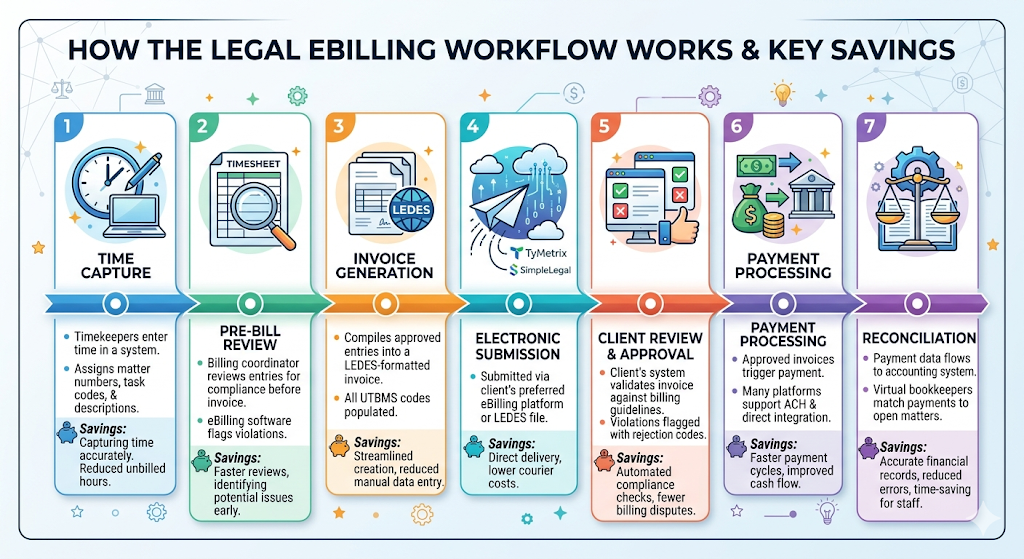
How the Legal eBilling Workflow Actually Works
Here is what the process actually looks like from start to finish, and where the savings show up at each step.
- Time capture. Timekeepers enter time in a time-tracking system, assigning matter numbers, task codes, and narrative descriptions.
- Pre-bill review. The billing coordinator reviews time entries for guideline compliance before invoice generation. eBilling software flags violations automatically.
- Invoice generation. The system compiles approved entries into a LEDES-formatted invoice with all required UTBMS codes populated.
- Electronic submission. The invoice is submitted through the client's preferred eBilling platform or directly via LEDES file transfer.
- Client review and approval. The client's eBilling system validates the invoice against their billing guidelines automatically. Compliant invoices advance to approval; violations are flagged with specific rejection codes.
- Payment processing. Approved invoices trigger payment. Many platforms support ACH and direct payment integration.
- Reconciliation. Payment data flows to the firm's accounting system. Virtual bookkeepers handle this reconciliation loop, matching payments to open matters and flagging discrepancies
LEDES and UTBMS: Why Compliance Is Non-Negotiable
LEDES formatting is the technical standard that makes invoices machine-readable. Without it, an invoice submitted to a corporate eBilling system either fails to import or requires manual intervention, which triggers delays and potential rejection.
UTBMS codes are a standardized taxonomy for legal tasks and expenses, organized into four code sets:
- L-codes: litigation tasks (e.g., L110 = Fact Investigation/Development)
- A-codes: counseling tasks (non-litigation matters)
- P-codes: project tasks
- E-codes: expense categories
Incorrect or missing UTBMS codes are among the most common reasons invoices are flagged. The American Bar Association's 2024 Legal Technology Survey confirms that UTBMS training and eBilling compliance are now among the top five operational priorities for firms serving corporate and insurance clients.
Where Virtual Bookkeeping Fits In (and Why It Matters)
eBilling software handles invoice creation and submission. What it does not do is manage the money once it arrives.
Payments land in trust or operating accounts. Then they need to be matched to open matters, applied to client balances, reconciled against your chart of accounts, and reported to partners. If any of that slips or gets done inconsistently, you lose the financial visibility that eBilling was meant to give you in the first place.
Bookkeeper.law fills that gap with virtual bookkeeping built specifically for law firms. Their services include:
- Three-way trust account reconciliation: keeping your trust account reconciliation, including IOLTA compliant with bar rules
- AR monitoring and follow-up: tracking outstanding invoices and flagging aging receivables before they become write-offs
- Matter-level profitability reporting: connecting eBilling data to real cost accounting so you can see which matters actually make money
- Month-end close support: delivering clean books to your CPA without the last-minute scramble
- Integration with legal accounting software: works with Clio, QuickBooks, and other platforms your firm already uses
The combination of eBilling software and dedicated legal virtual bookkeeping creates a complete revenue cycle: invoice creation, compliant submission, payment collection, accurate reconciliation, and financial reporting. For small and mid-size law firms that cannot justify a full-time controller, this combination delivers the financial infrastructure of a much larger operation at a fraction of the cost.
The Numbers That Prove eBilling ROI
Run the numbers for a 20-attorney firm that pairs eBilling with dedicated virtual bookkeeping and the impact is hard to ignore:
Stop Leaving Revenue on the Table: Build a Complete Billing Cycle
For firms serving corporate clients, legal eBilling is no longer a nice-to-have. It is the infrastructure billing compliance requires and real growth depends on. Fewer rejected invoices, faster payment cycles, recovered attorney time, and financial data you can actually use. Firms that hold off are writing down revenue and carrying unnecessary AR with every billing cycle.
But eBilling software only gets you halfway there. Reconciling payments, monitoring AR, maintaining compliant trust accounts, and reporting practice economics accurately all require dedicated legal bookkeeping expertise working alongside it.
Bookkeeper.law offers virtual bookkeeping built specifically for law firms. Their team works alongside your eBilling platform and turns billing data into accurate, real-time financial visibility your whole firm can act on.
Schedule a free consultation with Bookkeeper.law to see how virtual bookkeeping integrates with your eBilling workflow and what a complete legal revenue cycle looks like for your practice size.
Frequently Asked Questions
What is legal eBilling and how does it differ from sending invoices by email?
Legal eBilling is a structured electronic system where invoices are formatted according to LEDES standards and submitted through a billing platform that validates compliance automatically. Emailing a PDF invoice is not eBilling. It requires manual review by the client and provides no compliance checking, audit trail, or structured data. True eBilling automates validation, submission, and tracking in a single workflow.
Is legal eBilling only for large law firms working with corporate clients?
No. Any firm that works with commercial clients, insurance carriers, or government entities can benefit from eBilling. Many corporate legal departments now require eBilling from all outside counsel, regardless of firm size. Small and mid-size firms that adopt eBilling early gain a competitive advantage in winning and retaining commercial clients who have billing compliance requirements.
How long does it take to implement legal eBilling software?
Most mid-size firms complete basic setup in 4-8 weeks. The critical steps are connecting to existing time-tracking and accounting software, mapping existing billing codes to UTBMS codes, training timekeepers on compliant time entry, and onboarding clients to the new submission process. Firms that pair implementation with a virtual bookkeeper typically see faster adoption because financial reconciliation processes are built correctly from day one.
What happens when an eBilled invoice is rejected by a client?
When an eBilling platform rejects an invoice, it returns a specific rejection code that identifies the violation, such as an incorrect UTBMS code, block billing, an unauthorized rate, or an unapproved timekeeper. The firm's billing coordinator can then correct the specific line item and resubmit. Most rejections are resolved at this stage. This is far faster than the informal dispute process under paper billing, where rejections often surfaced weeks after submission with no structured explanation.