


If you've ever sat in a partner meeting where compensation was on the agenda, you already know how quickly things can get tense.
Compensation disputes are cited as one of the most common reasons law firms collapse, according to Yale Law & Economics Research Paper No. 521. When compensation is tied directly to firm performance, partners become highly sensitive to internal problems because their individual income rises or falls with the firm’s overall success.
Performance-based compensation models have become a popular attempt to address this tension. The concept is simple: tie what attorneys earn to what they actually produce. The challenge, however, lies in how firms define production.
The eat-what-you-kill model sits at the center of that debate. It’s a high-stakes system that can drive massive growth—or create a divided partnership. This guide explains how it works and the true meaning of this compensation structure for your firm.
Purpose of Attorney Compensation in a Law Firm
Attorney compensation can shape how a law firm operates. The structure you choose influences partner collaboration, individual performance, and business development efforts.
A well-designed compensation system rewards the behaviors your firm actually wants to encourage.
In practice, a compensation model determines:
- How partners prioritize business development
- How billable hours and collections are valued
- Whether collaboration or competition is rewarded
- How equity and non-equity partners are differentiated
- How firm profits are distributed
When compensation feels arbitrary or misaligned with effort, issues follow—from disengagement to reduced billable hours. Getting the model right matters more than most firms realize, often not until it’s too late.
What Is the Eat-What-You-Kill Model?
The eat-what-you-kill model is a compensation structure where attorneys are paid based on the revenue they personally generate for the law firm. Instead of earning income based mainly on seniority or overall firm profits, compensation is tied to the clients an attorney brings in, the work they perform, and the fees that are actually collected.
Under this model, each attorney essentially operates like their own business inside the firm. The firm provides shared resources such as office space, staff, and administrative support. In return, each attorney pays their share of firm overhead, and their remaining earnings reflect the revenue they produced.
Why the Eat-What-You-Kill Model Appeals to Law Firm Partners
For high-producing attorneys, this model has obvious appeal because it:
- Rewards individual effort directly. If you're a rainmaker attorney who brings in significant business, you don't want your compensation diluted by partners contributing less. In short, the more you generate and collect, the more you earn.
- Removes the need to negotiate recognition. Partners who invest in business development, maintain strong realization rates, and keep their utilization rate high can see those efforts reflected in their compensation automatically.
- Reduces resentment between partners. One of the biggest sources of friction in law firm governance is the perception that high producers are subsidizing lower-producing partners. Tying compensation to individual output makes the system feel more transparent and merit-based.
- Encourages accountability. When your earnings depend on your own collected revenue, billable hours, and origination credit, you have a direct financial incentive to stay productive and manage your client relationships well.
Calculating Attorney Compensation Under Eat What You Kill Model
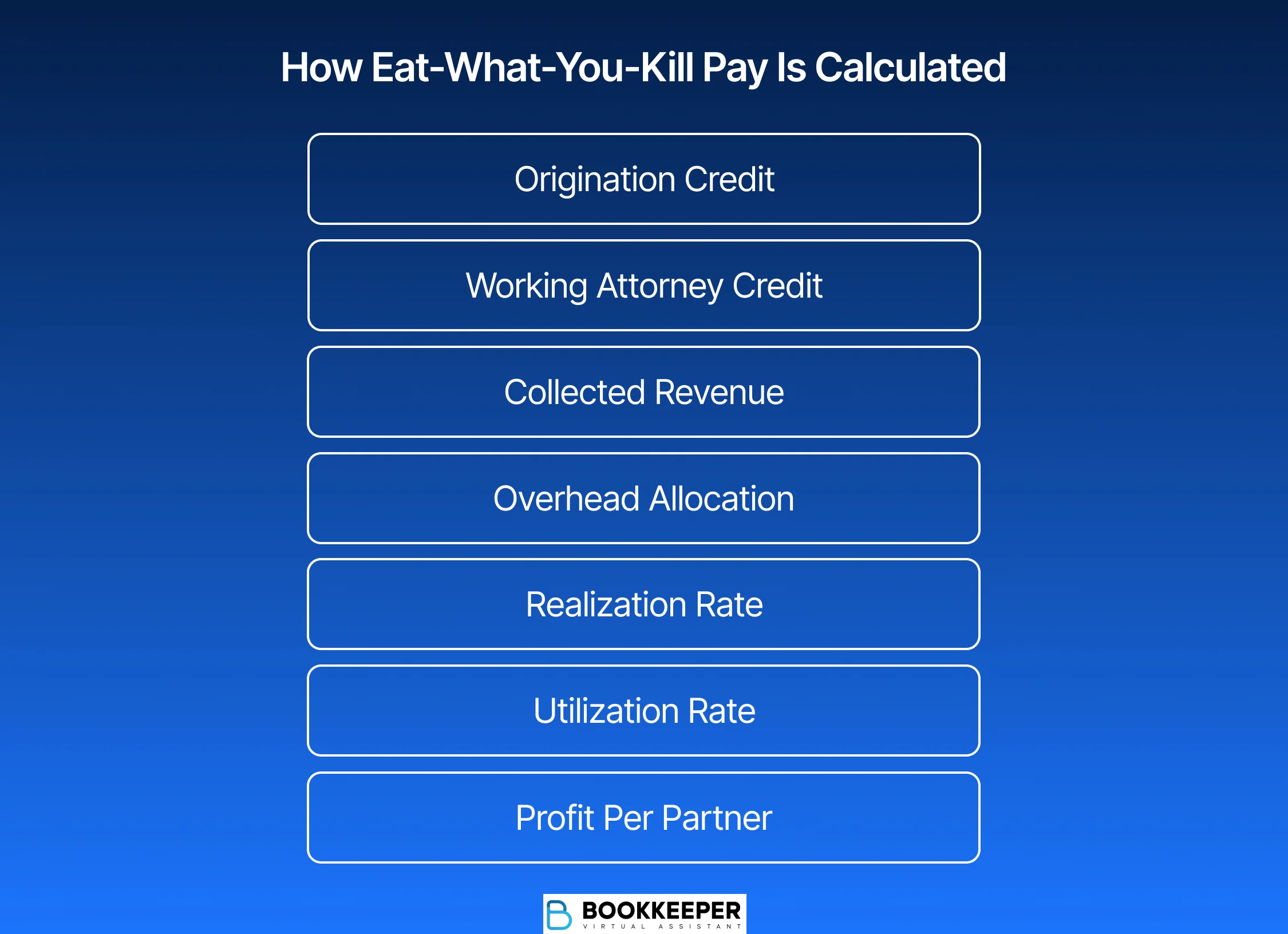
The specific formula varies by firm and requires precise financial reporting where experienced legal bookkeepers often play a key role. Below are the common metrics law firms track when calculating compensation:
- Origination Credit: This is the revenue credit assigned to the attorney responsible for bringing a client to the firm. Some firms assign 100% origination credit to one attorney, while others allow shared client credit between partners who collaborated on the relationship.
- Working Attorney Credit: This reflects the revenue credit assigned to the attorney who performed the legal work. In many firms, origination and working attorney credit are split, often 30/70 or 50/50, depending on the partnership agreement.
- Collected Revenue: Most eat-what-you-kill formulas are based on collections rather than billings. This means compensation is tied to revenue actually received, not just invoiced. It aligns earnings with real cash flow and encourages attorneys to monitor accounts receivable.
- Law Firm Overhead Allocation: Each attorney is charged a proportional share of firm overhead, including rent, staff salaries, technology, insurance, and administrative expenses.
- Realization Rate: Realization rate measures the percentage of billed fees that are actually collected. A high rate indicates strong billing and collection practices. A low rate reduces the revenue base used to calculate compensation.
- Utilization Rate: This metric tracks how much of an attorney’s available time is spent on billable work. Higher utilization generally signals stronger productivity and greater revenue contribution.
- Profit Per Partner (PPP): Although the eat-what-you-kill model focuses on individual performance, many firms still track PPP as a benchmark of overall profitability and competitiveness.
Eat-What-You-Kill Model Formula
The actual formula in your partnership agreement will be more detailed, but this gives you a sense of how the moving parts interact. Most firms use a formula similar to:
Partner Compensation = (Collected Revenue x Allocation %) - Direct Expenses - Share of Firm Overhead
This formula shows how the key financial components work together.
Example of How It Works
Let’s look at a simple example:
- Collected Revenue: $500,000
- Allocation Percentage: 40%
- Direct Expenses: $50,000
- Share of Firm Overhead: $100,000
Step 1: Apply the allocation percentage
- $500,000 × 40% = $200,000
Step 2: Subtract direct expenses and overhead share
- $200,000 − $50,000 − $100,000 = $50,000
Final Compensation: $50,000
Pros and Cons of Eat-What-You-Kill for Law Firms
No compensation model is perfect. Understanding where the eat-what-you-kill model works well—and where it breaks down—helps determine whether it is the right fit for your firm.
Advantages
The model is best suited for law firms where attorneys work largely independently, have distinct client bases, and prefer individual accountability over shared outcomes.
- Directly rewards high producers. Attorneys who build strong client relationships and maintain strong collections see their compensation grow in proportion to their measurable contributions.
- Improves retention: High-performing partners are less likely to leave when they feel their compensation accurately reflects the revenue they generate.
- Drives motivation: Because earnings are directly tied to performance, attorneys have a clear financial incentive to increase billable work, improve collections, and expand their client base.
- Creates financial transparency: Compensation is tied to measurable inputs such as billable hours, collected fees, and origination credit. This reduces ambiguity and minimizes perceptions of internal politics.
- Incentivizes business development: When origination credit is part of the formula, attorneys have a direct financial reason to invest in growing the firm’s book of business.
- Reduces unfair cost concerns: Partners can clearly see how compensation is calculated, limiting the perception that top producers are subsidizing underperformers.
Disadvantages
The model tends to be less effective in firms that rely heavily on collaboration, cross-selling, or practice group performance metrics.
- Undermines firm-wide collaboration: When partners compete for origination credit, they may hesitate to refer clients internally or share relationships.
- Certain roles at disadvantage: Attorneys who focus on complex, lower-revenue work, firm management, or mentoring may be undercompensated relative to their actual value to the firm.
- Encourages client hoarding: Some attorneys may avoid involving colleagues in client matters to protect their origination and working attorney credits, which can create service gaps and increase risk.
- Overemphasizes individual revenue: Because the model centers on personal collections, it may overlook broader firm-level costs. Attorneys who generate high billings but operate inefficiently can appear highly productive while reducing overall profit.
Best Practices for Implementing the Eat-What-You-Kill Model
If your firm is using or planning to adopt this model, the following practices can reduce its downsides while preserving its core benefits:
- Define origination credit clearly in your partnership agreement. Ambiguity around shared client credit can be a cause of partner compensation disputes. Spell out exactly how splits are handled and what happens when client relationships evolve.
- Build in collaboration incentives. Consider allocating a separate credit pool for attorneys who refer matters internally or co-manage cross-practice clients. This offsets the incentive to work in silos without replacing individual tracking.
- Base compensation on collected revenue. Tying pay to collections reinforces healthy billing practices and keeps compensation aligned with actual firm cash flow.
- Document overhead allocation transparently. Partners are far less likely to challenge cost allocation when the methodology is clearly explained in financial reports. Publish the formula and review it regularly.
- Establish a compensation committee with a defined process. A committee that can evaluate exceptional circumstances gives the system flexibility without undermining objectivity. This may include situations such as a major client loss, an unusual expense year, or a partner leave.
- Invest in accounting systems that support accurate reporting. The model depends on clean, reliable data. Your firm should be able to track attorney performance metrics, origination credits, collections, and overhead allocation in real-time.

Alternatives to the Eat-What-You-Kill Model
If you're evaluating whether this model is the right fit, you can also consider these common alternatives:
- Lockstep Model: Partner compensation is based primarily on seniority. Partners advance through compensation tiers based on years at the firm, regardless of individual production.
- Modified lockstep model: This variation introduces performance weighting while retaining a seniority-based structure. It allows firms to reward high performers without fully abandoning the lockstep structure.
- Hybrid compensation model: Attorneys receive a guaranteed base salary or draw, plus performance-based bonuses tied to individual or practice-group metrics. This model offers income stability while still incentivizing productivity and business development. It is commonly used for non-equity partners and senior associates.
- Merit-based compensation model: Compensation is based on a broad evaluation of contributions, such as mentoring, pro bono work, and client development, rather than a fixed formula. It works best in firms with strong communication and a compensation committee that partners genuinely trust.
How Bookkeeper.law Can Support Your Firm
Whatever compensation model your firm uses, it only works when your financial data is accurate and up-to-date. At Bookkeeper.law, we specialize in providing legal bookkeepers who become an integrated part of your practice by helping with:
- Daily bookkeeping
- Trust accounting and IOLTA compliance
- Retainer and matter-based accounting
- Financial reporting that keeps partners informed
- Reconciliation and error prevention
- Cash-flow tracking and expense management
Our legal bookkeepers understand the unique financial demands of law firms and the way money moves through a legal practice. If you’re ready to build a cleaner, more reliable financial foundation, reach out to learn how we can support your law firm’s financial management.
Conclusion
Compensation is never just a number. It signals what your firm values and shapes how it grows.
The eat-what-you-kill model rewards individual performance and financial accountability, and for the right firm, it can be a powerful driver of growth. It works best when it's implemented thoughtfully with clear rules, transparent overhead allocation, and reliable accounting systems.
Understanding how the model works, where it can create tension, and what alternatives exist gives your firm the context to make an informed decision. This is especially important whether you’re designing a compensation structure from scratch, or planning for firm succession as your practice evolves.